• Pages

  • Categories

  • Photos

    Variable Clown Treefrog Goo Obo Gudgeon Amazon Mccaw Parrots
  • Archives

  • Options

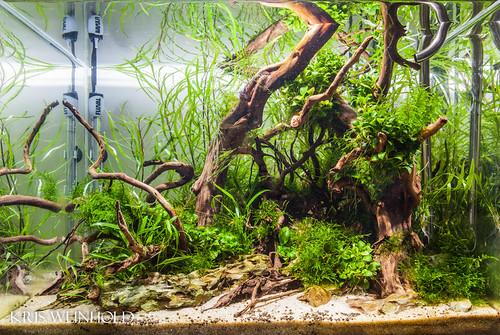
50G - 2 Months

January 4th, 2009

It’s been about two months since I first setup the aquascape in my 50G aquarium. The plants are growing in very well, and after many hydrogen peroxide treatments, the algae I was experiencing is finally starting to wane. Unfortunately, the H2O2 also took a toll on many of the fish I had in this tank. Otherwise, I’ve removed a few more rocks from the right foreground to allow for more focus on the woodwork there. Ideally, I’d like the wood to look like a fallen tree.

50G - 2 Months

The HC and hairgrass are both starting to take off, which I’ve been waiting awhile for. I’ll probably tweak a few more things, removing a couple plants from the scape, but more/less, I’m pretty pleased with how it’s progressing. As always, comments/critiques welcome!


Business Broker

Rescaping By Commitee

January 2nd, 2009

Earlier in the week, one of our fellow GWAPA members, Dave Williams, invited a few people over to rescape his large 180G aquarium. With a tank this large, a little bit of help to plant can save a huge amount of time. By the time we arrived, Dave had done all of the prep work required, so we could start directly with the hardscape. He already had a vision in his head about the final aquascape, which was to bundle branches of wood together to form “trees,” and hopefully provide enough perspective with plants to have the effect of standing in the forest, with a mountain off in the background.

Dave's 180G Rescape

So, we got started by placing the trees in the tank, and then using several pieces of porous mossy rock to build up our mountain. After we did this, we realized that the mountain looked a little bit out of place, being the only rock in the tank.

Dave's 180G Rescape

So, we added a complementary mountain to the left of it. After several opinions were tossed around, we all decided that we didn’t like the separate mountain ranges, and would rather put a smaller peak in part of a larger mountain range. We were also trying to envision which pieces of the background would end up visible once the tank was planted. Ultimately, we ended up with what you see below.

Dave's 180G Rescape

Now, it was time to begin planting the tank. We added just enough water to allow for the plants to stick, and went to town. In the mountain itself, we wedged Cryptocoryne parva into any crack we could. The foreground consisted of hairgrass and a dwarf Lilaeopsis species. Anubias, Cryptocoryne crispatula var. ‘Balansae’, Cryptocoryne walkeri, Pogostemon helferi, among others made it into the tank.

Dave's 180G Rescape

Now it was time to fill the tank with water. As you can imagine, it takes quite awhile to fill a tank with 180 gallons of water slowly enough not to disturb the plants. Dave sent a picture of how the tank looks with the water in it.

Dave's 180G

As you can tell, plenty of growing needs to happen to really fill in a tank this size, but I’m very interested to see how this aquascape shapes up once it reaches maturity. I also recommend scaping with other people. It’s great to hear instant feedback on your original hardscape and plant selection ideas, so that you can make any minor adjustments before you finish.

Business Broker

Walking Thru the Woods

December 30th, 2008

Firstly, I hope everyone had a nice holiday, and continue to enjoy life as we move into 2009. Yesterday, my wife, dogs, and I took a hike through some trails near our house which I have documented several times previously on this site. These trails wind in-between the Little and Middle Patuxent Rivers, with one segment shown below.

Middle Patuxent River

Of course, the weather is far too cold for any aquatic vegetation to be present in the water now, but as you can see the rocky floor of the river is not especially good to support plant life anyhow. I have seen Potamegeton in here previously, however.

Clear Water, Rocky Bottom

With all of the leaves fallen, you could see far more of the forest than normal. While this did make us a little bit more aware of otherwise unseen homes and roads, we also had the opportunity to see some really neat trees that we would have missed at other times of the year.

Neat Tree

And of course, our dogs took full advantage of the more open space, running wild in the few secluded areas that we let them off the lease. Bella, in particular, our black lab and weimaraner mix was racing around too quickly to get a clear picture.

Bella Running Crazy

Below is another set of trees that I found particularly interesting. I haven’t a clue whether this could be one of them, but I’m certainly reminded of the old Indian marker trees that are present through Appalachia and surrounding forests.

Neat Tree

Along those same lines, it’s always thoughtful to remember that although some of these wilderness areas look pristine and untouched, that we’re only a part of a long line of people who have walked the land. In this case, old bridge remnants lay moss covered as memories of some old road that passed overhead.

Old Bridge Supports

I guess it’s true that eventually, the forest will fully reclaim these structures. All the while, I’ll enjoy walking and exploring the forests and waterways near our house.

Business Broker

75G - 2 Weeks In

December 21st, 2008

I wanted to give an update on my 75G aquarium, roughly two weeks since I rescaped it. As you can tell, many of the stems in the background need a trim, but otherwise, the midground is pretty much intact. I still haven’t decided on a foreground plant, which I really need to do. Right now, I’m kind of thinking of using Echinodorus tenellus var. ‘micro,’ which is a small grassy plant that turns red under intense lighting.

75G - 12-21-2008

The Hottonia palustris is growing really well in the right-background, and is a very unique looking plant. Right now it’s growing tall, and then trailing a little bit toward the front glass as it nears the water surface, which is exactly what I want.

Hottonia palustris

The tank is also packed with about 50-70 Iriatherina werneri (Threadfin rainbowfish), and a few other Melanotaenia praecox (Dwarf Neon rainbowfish) that I had from another tank. While I was taking photos they all congregated in a single area underneath the arch, so it looks like they’re packed far denser then they normally are.

I. werneri & M. praecox

Also, the Proserpinaca palustris (Mermaid weed) that I found locally this past summer is growing nicely, and has turned a nice burgundy color under the lights. This particular variety appears to have extremely fine-tooth leaves, as compared to some of the ones I’ve seen in the hobby. I think I actually prefer this look.

Proserpinaca palustris

Overall, I’m pleased with how this aquascape is turning out. As mentioned, I still need to work on a foreground and trim some of the stems, but otherwise, I’m looking forward to it maturing a little bit more. Comments/critiques welcome as always!

Business Broker

Plants For Sale

December 18th, 2008

Since I maintain a few tanks, it’s fairly common that I end up with more trimmings than I know what to do with. Many of these plants are fairly uncommon in the hobby, and often completely unavailable through regular retail outlets. I sell many of my plants through aquatic plant forums, and to local club members, but I want to make known that many of the plants I talk on this website are available for sale. Since I’m not running a nursery, the availability of any individual plant will vary from time-to-time, so please contact me if you’re looking for something in particular that’s not listed.

More information can be found on my Plants For Sale page in the sidebar, and at the top of this page.

Business Broker

Rotala sp. ‘Araguaia’

December 16th, 2008

Rotala sp. ‘Araguaia’ is one of the plants that my wife brought back for me from Aqua Forest Aquarium in San Francisco, CA.

Rotala sp. 'Araguaia'

It’s one of the nicest new plants I’ve seen enter the hobby in a long time, as it has an oblong leaf shape that turns a pumpkin orange color. In addition, it branches readily, creating a nice bushy effect without too much effort. I haven’t found this plant to be very demanding at all.

It grew in my wormstrate substrate without any additional dosing, besides CO2, but definitely grows faster and a little bit larger in my 50G with high light, CO2, and added fertilizers. I got good coloration in both conditions.

Unlike species like Rotala sp. ‘Green Narrow’, this variety grows vertically, which provides a nice contrast to the aforementioned plant.

Right now, the source of this plant is unknown, despite being named as Araguaia.’We’re in the process of trying to flower and ID it properly, but that can be a long and laborious process.

All in all, I don’t have any complaints about Rotala sp. ‘Araguaia’. Therefore, I can recommend this plant to most people as something different from the more common Rotala rotundifolia. Currently, most stores in the U.S. don’t have it, but it’s available online from hobbyists on sites like aquaticplantcentral.com.

Business Broker

50G - 5 Weeks

December 15th, 2008

It’s been about 5 weeks since I first planted my 50G aquarium, and as you can see the plants are really starting to grow in. In some ways, I’m starting to think that this isn’t a good thing. I’m reconsidering all of the Blyxa japonica on the left side midground, as it just seems too imposing. I need to come up with a shorter plant there. Previously, I had just jammed the B. japonica down into the substrate prior to photos, but that’s not a great solution.

50G - 5 Weeks

The Hemianthus callitrichoides has finally started to spread a little bit in the foreground, so I’m hopeful that it’ll soon really gain some momentum and fill in. I was also able to get some Fissidens fontanus moss from another GWAPA member, which I attached to the large root ball on the left side. The stems, especially the Rotala macrandra ‘green narrow’, are really growing fast right now. The only disappointment to this point is the Hemianthus micranthemoides in the right midground, which is growing more veritical than bushy. I’m also dealing with a little bit of hair algae, which I’m trying to rectify by starting a small dosing regimen of traces, iron, potassium, and Seachem Excel. Largely, I’m pleased with how things are proceeding, but recognise that a few adjustments will be in order. Comments welcome!

Business Broker

Utricularia gibba

December 10th, 2008

I was first introduced to Utricularia gibba at a GWAPA meeting when another member asked the host for a pair of tweezers, and promptly began to remove a few strands from their tank. Utricularia gibba is often mistaken for algae due to its similar appearance, but it is actually a carnivorous plant that survives by trapping tiny microorganisms in its bladders. At least, if you have ever had an algae outbreak, you could take solace that with proper attention, the tank could relatively easily be made algae-free. Unfortunately, if you find Utricularia gibba in your tank, you’re not so fortunate.

Utricularia gibba

This plant thrives in the same conditions that your other plants do, so your only recourse is to manually remove thread after thread with a pair of tweezers. The most common way that a tank becomes infected is when Utricularia gibba hitch-hikes on some other plant that you introduce into your aquarium.

Utricularia gibba Bladders

Utricularia gibba Bladders

From there, it’s just a matter of time before the bladder-ridden threads wind themselves in amongst the stems of your beautiful plants. You may actually wish to have this plant in outdoor water gardens, however, as Utricularia gibba does produce a pretty yellow flower above the surface.

Utricularia gibba Bladder

Utricularia gibba Bladder

Fortunately, I’ve never had a huge problem with this plant. I’ve introduced it to a couple of my tanks in the past, but luckily was able to contain and rectify the situation shortly thereafter. So, keep an eye out for Utricularia gibba whenever you add new plants to your aquarium.

Business Broker

GWAPA: Holiday Potluck!

December 8th, 2008

GWAPA closed 2008 with a holiday potluck at a member’s house in Reston, VA. The club combines the November and December meetings since it’s hard for people to make two meetings during the holiday season. While the meeting was mostly a social, we did conduct a little bit of club business, electing the board of directors for 2009. I will continue on as president of GWAPA next year, so I’ll soon have to buckle down and work with the other board members to assemble a great schedule for the upcoming year.

Michael’s house was a great place to hold our final meeting because he was a basement full of tanks, which we eagerly perused. Michael has been to the Peruvian Amazon a couple times with the same company that I traveled with, and he has actually brought back hundreds of fish that he personally collected there.

Michael's Fishroom

It was great to look through all of the tanks at the wild South American fish, including piranha, pencilfish, cichlids, characins, catfish, and more. He also had some tanks with other species, such as his rainbowfish aquarium below.

Michael's Rainbowfish Tank

Finally, we had a huge auction, which took us over an hour to complete. There were 144 bags of plants, fish, shrimp, etc. in the auction, with variety that rivaled the auction at the AGA Convention last month. It was a nice close to a great year in the club.


Business Broker

75G - New Aquascape!

December 5th, 2008

I guess you could say that the Aquatic Gardener’s Association Convention last month inspired me to work on my tanks. After setting up my 50G, and moving my 40G, it was finally time to rescape my 75G aquarium. I usually don’t do a whole lot of planning prior to starting a new aquascape. Usually, I just pick the materials I want to use, and kind of fit them together, trying different combinations, until something clicks. Well, this time, I decided to try something new.

Hardscape Plannig

The day prior to the rescape, I pulled out my porous mossy rock and African bogwood, and began working on a hardscape on the floor. Eventually, I decided that I wanted an archway, slightly off-center, with piles of rocks around it. Then, the next day, when it was time to rescape, it was simple to transplant the hardscape into the tank.

75G Hardscape

Obviously, once in the aquarium, I made a few adjustments, spreading out the hardscape, and adding a few extra pieces of rocks and wood to fill it out. I also knew that Narrow leaf Java Fern would feature prominently in this aquascape, after receiving a huge amount of it from a very generous GWAPA member. (BB, thank you so much!) Microsorum pteropus is a wonderful plant to use to fill in the gaps between pieces of the hardscape, making the whole thing look like more than a pile of rocks and wood.

Narrow Leaf Java Fern

After quite a bit of planting, I finished the aquascape. A lot of growing needs to happen, and actually, I still need to plant the foreground, but otherwise, I’m pretty happy with how it’s turned out. Of course, I’ve spent a number of hours staring at it, so I’m sure I see things a little bit differently than a fresh set of eyes.

75G - New Aquascape!

So, with that in mind, I’d love to hear your comments and critiques!

Business Broker

« Previous Entries